
Major County Release Outcomes
A Major County release is an event tied to a booking, court order, or sentence. It does not mean every case or duty has ended. A person may leave the Major County Jail after bond, recognizance, dismissal, a court order, time served, or completion of a county sentence. The same person can also leave the county roster through a transfer to the Oklahoma Department of Corrections, another jail, a tribal or federal authority, ICE, a hospital, or another custodian. Those results are not interchangeable.
The operating custodian holds the best record of the physical event. For a county booking, that is the Major County Sheriff's Office jail register or discharge entry. The court file explains the legal basis. OK VINE can report a custody change. ODOC records describe state custody and supervision, while federal and immigration locators cover their own systems. A careful search names both the event and the agency that recorded it.
- Discharge
- The recorded end of custody by one agency, which may be community release or transfer.
- Time served
- A court-recognized completion of the custodial time stated in the judgment.
- Parole
- Conditional release from prison while the sentence continues under supervision.
- Probation
- A community sentence that may be imposed without a prison term.
- Detainer
- A request from another authority for notice and possible transfer when local custody ends.
Major County Inmate Release Types
The release label controls the next step. Bond lets a case proceed while the person is outside physical jail custody, but another hold can still prevent departure. A dismissal may end one count or case without resolving others. Time served or sentence completion addresses a custodial term. A transfer ends Major County custody but begins or continues custody elsewhere. Escape and death also change a roster, yet neither is an ordinary release into the community.
| Recorded outcome | Meaning and next source |
|---|---|
| Bond or recognizance | County custody may end while prosecution continues. Check the jail discharge entry and ODCR case. |
| Court order or dismissal | The court supplies authority, but the jail record confirms actual departure and other holds. |
| Time served or sentence complete | The custodial part ends as recorded. Check whether supervision follows. |
| Transfer | Follow ODOC, another county, USMS, ICE, tribal authority, or the named receiving custodian. |
| Parole | Prison custody changes to conditional community supervision. Confirm later ODOC status, not just a board vote. |
Use the agency's own phrase whenever possible. Writing “released from Major County custody to ODOC” is more accurate than saying “freed.” If the destination field is absent, request it. Community release remains unconfirmed until the transfer question is resolved.
Note: A bond posting is not an acquittal, dismissal, sentence completion, parole decision, or exact jail exit time.
Major County Release Record Fields
Oklahoma law gives the jail register special value. The Attorney General's summary of 51 O.S. § 24A.8 identifies the prisoner's name, commitment details, committing authority, description, and date or manner of discharge or escape as producible fields when the agency keeps them. A focused request for that entry is stronger than a broad request for an undefined inmate report.
| Field | What it shows |
|---|---|
| Name and identifying details | Connect the discharge to the right person and help separate common-name matches. |
| Booking number and date | Tie the release to one confinement rather than another arrest or sentence. |
| Committing authority | Identify the agency or court responsible for the initial custody. |
| Charges and case number | Connect the jail event with the proper Major County court file. |
| Discharge date and time | Show when jail administration recorded departure, if that timestamp is kept. |
| Manner of discharge | Separate bond, court order, time served, completion, transfer, escape, or death. |
| Destination or receiving agency | Show whether another custodian took control after the county leg ended. |
A judge may sign an order before jail staff finish identity, hold, and property checks. A docket can also post after physical departure. The jail discharge timestamp best answers when the person left that custodian. The file-stamped order best explains why the release was authorized. VINE records when a status event was transmitted, which may be later still.
Request Major County Release Records
The Major County Sheriff's Records Division is the direct source for a historical jail release. Ask for existing jail-register, booking, and discharge entries. Include a full name, date of birth if known, approximate confinement date, and any booking or case number. Narrow wording helps staff locate the correct entry and avoids asking the office to create a new timeline.
- Identify the booking with name, aliases, approximate dates, and a known identifier.
- Ask for booking date and time, committing authority, charges, case number, discharge date and time, discharge manner, and transfer destination if kept.
- Request redaction of exempt material instead of withholding the whole responsive record.
- State the preferred format, ask whether email is available, and request a cost estimate before chargeable copies are made.
- Seek certification only when needed because certified pages carry a different posted fee.
Major County Sheriff Records Division
500 E Broadway #4
Fairview, OK 73737
580-227-4471
Monday through Friday, 9 a.m. to 3 p.m.
The office posts paper copies at $0.50 per page, certified copies at $1 per page, and DVD or thumb drive at $1 per page as written on its page. Some reports may be emailed; some may require a subpoena. Oklahoma law calls for prompt, reasonable access, but the Sheriff posts no guaranteed completion time. Ask for the legal basis of a withheld part and for all segregable public fields.
Major County Release Record Law
The Oklahoma Open Records Act is codified at 51 O.S. §§ 24A.1 and following. Section 24A.5 governs prompt and reasonable access. Section 24A.8 covers law-enforcement records, including jail-register discharge facts when kept. It does not force an agency to create a record or establish one universal retention term.
A public roster is not the full legal record. Online disappearance does not show how long the Sheriff's underlying jail register remains available.
Juvenile, sealed, expunged, victim-identifying, medical, mental-health, informant, and active-investigation information may be restricted. Under 22 O.S. § 18, eligible people may seek to seal criminal and related public civil records from the same arrest or transaction. Eligibility depends on the disposition, offense, time, and history. Release or dismissal alone does not seal a record. The OSBI expungement unit implements qualifying orders for state criminal-history records.
Correct Major County Release Records
Major County release corrections follow the custodian that created the disputed entry. Booking, discharge, or Sheriff roster errors belong with the Sheriff's Office. Court docket errors, missing orders, and certified-file questions belong with the Major County Court Clerk. ODOC Sentence Administration handles state sentence and status calculations through the proper records route. No single office can rewrite a separate agency's independently held record.
Submit the exact field at issue and a source document that supports the correction. For example, provide the booking number for a jail entry, the file-stamped order for a court discrepancy, or the ODOC number and judgment for a sentence issue. Ask that each custodian correct or annotate its own system. If two identifiers conflict, keep the identity unresolved until an agency confirms the match.
Note: The Sheriff and Court Clerk share the Broadway county complex, but they occupy different suites and maintain different records.
Major County Release Orders Use ODCR
The Major County Court Clerk directs online users to ODCR. Searching only the OSCN county docket form can lead to a false conclusion that no Major County case exists. Use the Clerk's ODCR route, isolate the correct case by name or case number, and read the full event history.
Bond entries, recognizance release, dismissal, judgment and sentence, commitment, jail credit, revocation, warrant recall, satisfaction, and termination can explain legal authority. They do not necessarily show the moment of physical departure. When an online event conflicts with a signed order, request the file-stamped or certified document from the Clerk. Then pair it with the Sheriff's discharge entry to establish both authority and actual release.
Does “bond posted” prove the person walked out? No. It shows one condition was met. The jail must still clear other holds and record the discharge.
Search Major County Released Inmates
The official Major County inmate search is explicitly limited to people listed in custody. A current match can show booking time, charges, and more information. No match may reflect release, transfer, an update in progress, a spelling error, or custody under another agency. The Sheriff itself points users to VINE when someone may have been released or transferred.
- Search the Sheriff roster by name and note the date and time of the check. Treat a match as listed current custody, not a future release forecast.
- Search Oklahoma in VINELink for a person-specific custody event. Compare the reporting facility and identity details.
- Use Major County ODCR records to find the court event that may explain bond, dismissal, commitment, sentence, or warrant action.
- Request the Sheriff's discharge entry for the physical event, manner of discharge, and receiving agency.
- If transferred, continue with ODOC, another sheriff, USMS or BOP, ICE, or the named tribal authority.
Keep a short audit note with the full name, identifier, system, query time and time zone, exact status wording, event date, reporting agency, URL, and mismatch. Dynamic results should be preserved with unrelated personal details minimized. Two copies of the same vendor-fed status do not count as independent proof.
ODOC Search for Major County Releases
The ODOC Offender Lookup covers people committed to or supervised by the Oklahoma Department of Corrections. It is not a list of every person booked in Major County. Someone who bonded from the county jail and never entered ODOC may have no state correctional incarceration record.
| Search field or detail | How to use it |
|---|---|
| ODOC number | Best first key because names and aliases can collide. |
| Name | Compare the middle name, age, physical description, photograph, offenses, and county references. |
| Status or location | Distinguish an institution, community supervision, and historical discharge. |
| Sentence and offense entries | Connect the state record to the right judgment rather than a different case. |
| Projected or historical dates | Treat a future date as tentative; pair a past date with the displayed status. |
ODOC says an exact inmate release date is confidential without a legitimate need and calls calculated dates tentative. Earned-credit level, misconduct, and achievement credits can change them. A parole eligibility date is not a release date, and a board result is not the door-out timestamp. For deeper state records, start with the ODOC Offender Info gateway.
The captured ODOC search form shows the statewide entry point used after a Major County transfer.
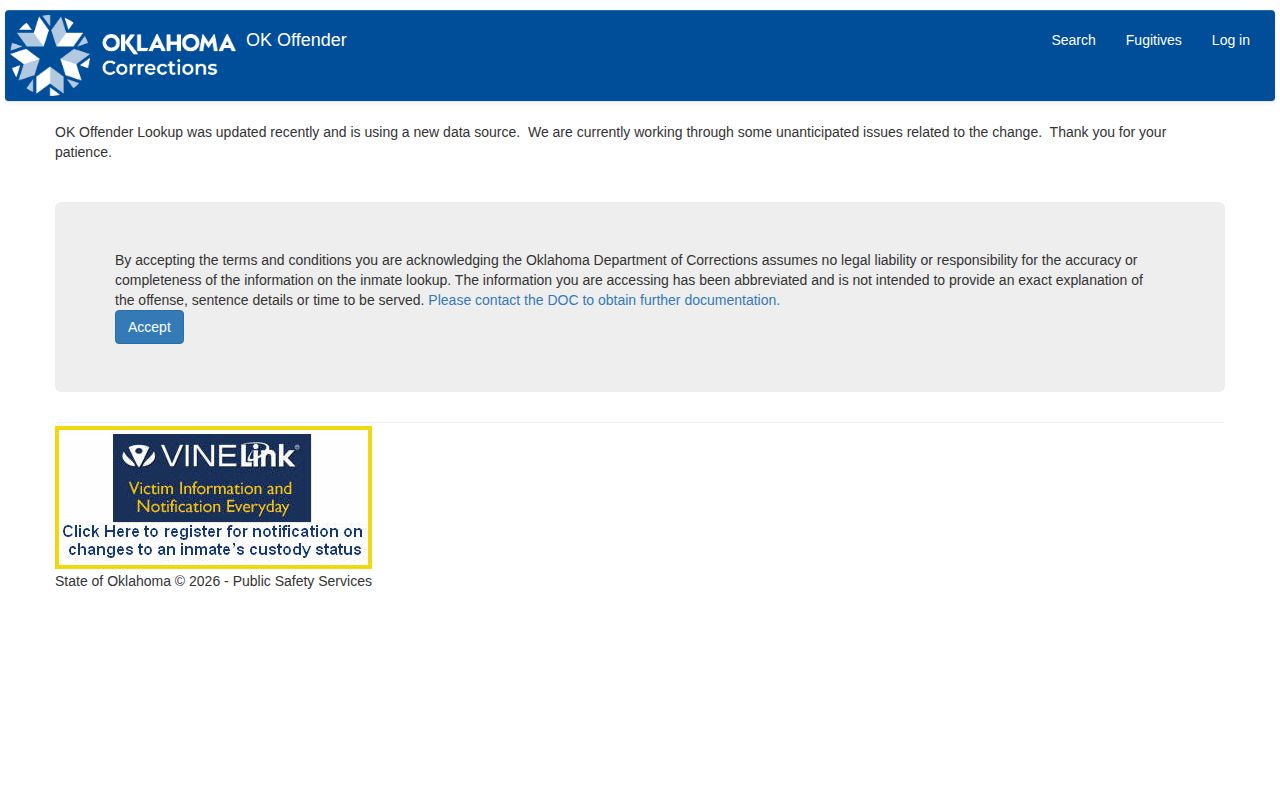
This state search belongs to the ODOC leg of custody and should not be used to infer a county-only bond release.
Major County Recent Release Limits
Major County publishes no official 24-hour or 72-hour released-inmate feed. The Sheriff's home page shows recent bookings, which is the opposite side of the custody event. The roster sorts current inmates by booking date and can display a booking photograph, but it advertises no release date, release reason, discharge time, archive, download, retention window, or fixed update schedule.
For a time window, ask the Records Division for existing jail-register discharge entries between exact start and end timestamps. Request date, time, manner of discharge, and the receiving agency if transferred. The office need not create a custom report that it does not keep. VINE works best for one known person, while ODCR explains individual court authority. Neither is a browseable county release list.
The Sheriff's current roster capture illustrates why the live search cannot preserve Major County releases.
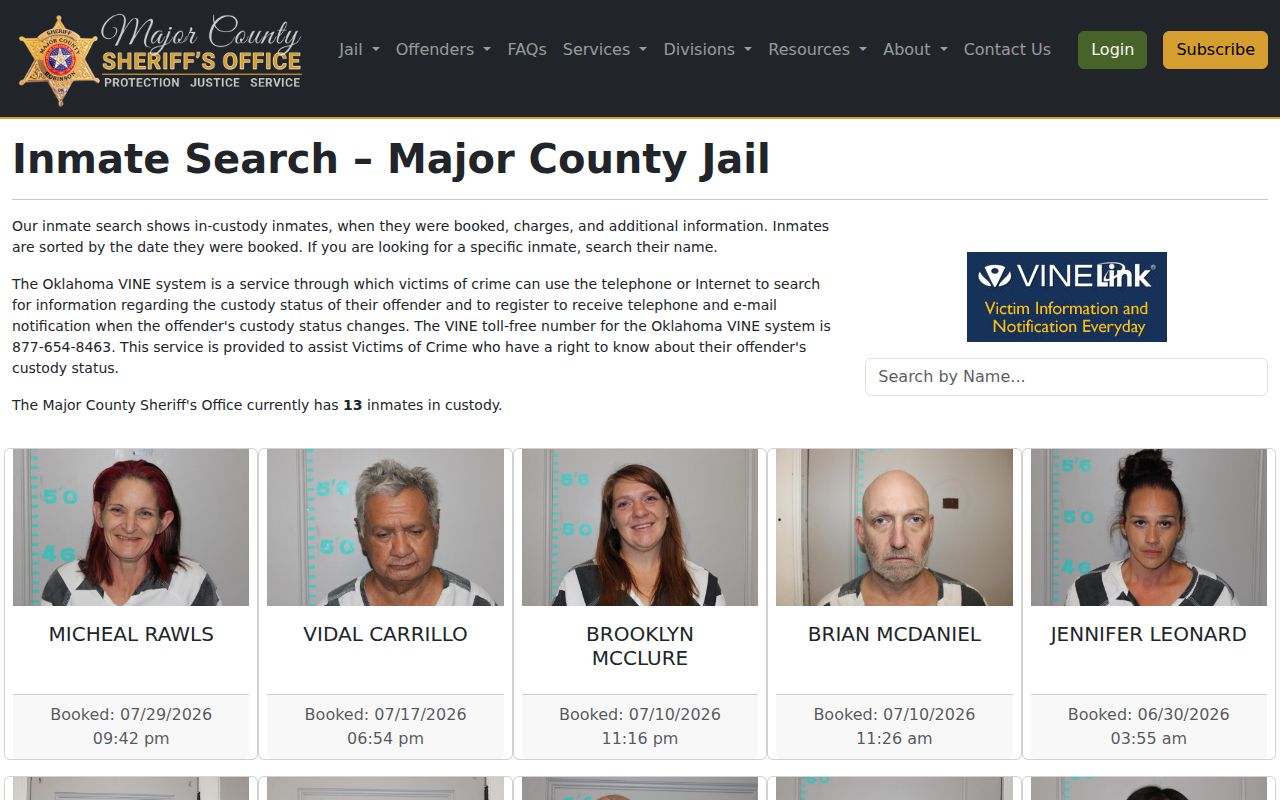
The page's own VINE fallback should be followed when a name disappears, then confirmed with a discharge record.
Major County Release Record Hours
Release-record work follows a narrower counter schedule than general Sheriff business. The Records Division receives in-person requests from 9 a.m. to 3 p.m. on weekdays. General administration lists 8:30 a.m. to 4:30 p.m., and dispatch operates around the clock. Reaching the county building late in the administrative day does not mean the records counter is still open.
Call 580-227-4471 before travel, especially when certification or a less common format is needed. Dispatch availability is for operations and urgent communication, not a promise that records staff can fill a historical discharge request at night. The office may email some reports, which can avoid a needless visit and paper copying.
Note: Confirm current hours before travel because posted schedules can change, while a records request may also need staff review.
Major County Release Alerts and Supervision
OK VINE and VINELink provide a person-specific search and notifications by web, telephone, and supported mobile channels. Read the status, reporting agency, facility, and event date together. A “released” event is the participating agency's report. A “transferred” event requires a search of the next custodian. VINE can lag and is not the permanent certified release record.
Parole and probation are separate from physical custody. ODOC supervises Oklahoma probationers and parolees, while the Oklahoma Pardon and Parole Board handles parole decisions. A favorable parole vote is not an exact exit time. Major County is covered by ODOC's Alva sub-office rather than a dedicated Fairview supervision office, so call before travel and do not assume every person reports at the public office. The Major County parole and probation resource explains how to separate active supervision from final discharge.
The Oklahoma Sex and Violent Offender Registry is a separate post-release channel only when a legal registration duty applies. Absence does not prove that a person was never incarcerated or released, and registry presence does not establish the day the person left Major County Jail.
The VINELink capture shows the statewide person-search entry that Major County itself recommends.
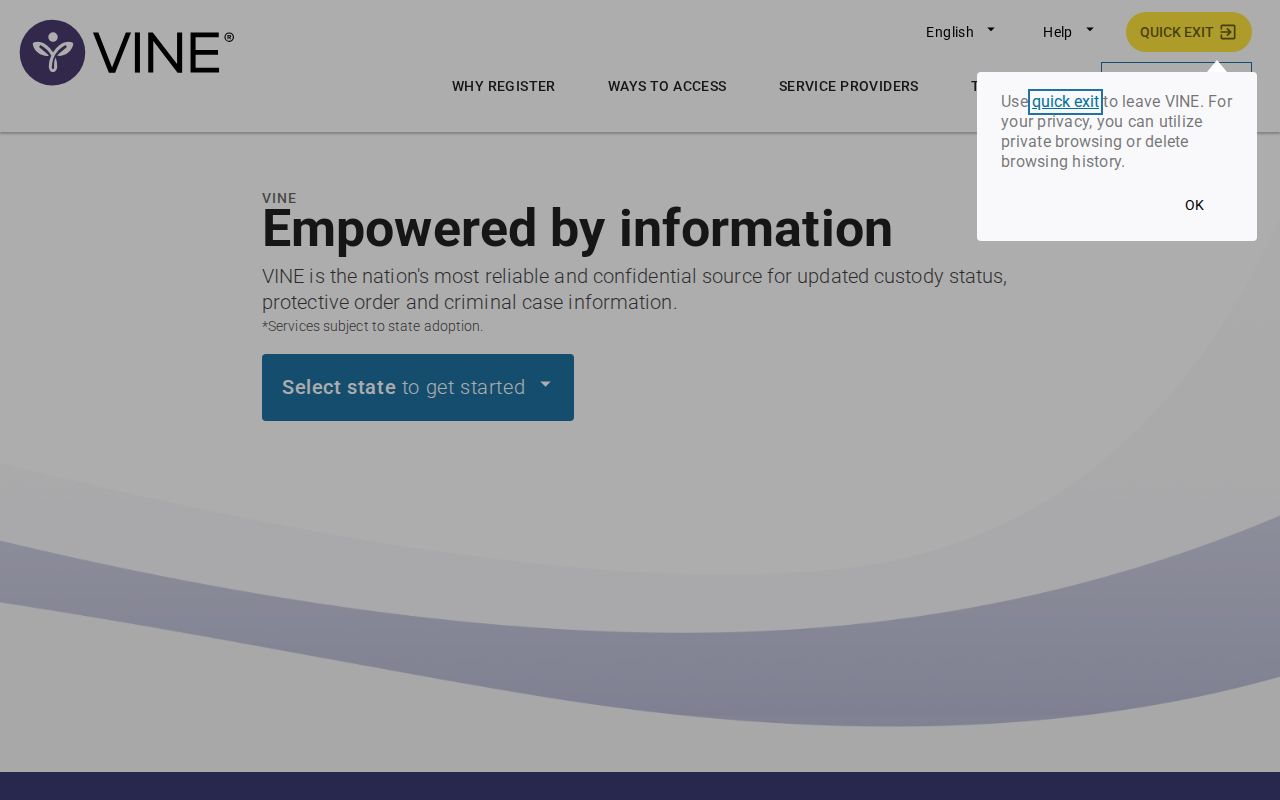
A notification should prompt confirmation with the jail, court, or receiving agency rather than replace those records.
Major County Release Search by Custodian
The correct system depends on who held the person. County jail discharge records establish a Major County physical release or transfer. ODOC Lookup covers state prison and state supervision. The BOP locator covers sentenced federal custody from 1982 forward, while federal pretrial movement may require the federal court and USMS. ICE's locator covers current custody and a limited recent-release window.
County jail: Sheriff register plus ODCR and VINE.
State system: ODOC status/history, PPB results when parole applies, and VINE.
Federal sentence: BOP locator plus the federal case record.
Immigration custody: Sheriff transfer destination followed by ICE ODLS.
An ICE detainer asks a facility for notice and a hold of up to 48 hours so ICE may assume custody. A county discharge to ICE is therefore a transfer, not proof of community release. The BOP locator and ICE ODLS cannot confirm a simple Major County bond-out.
Verify Major County Community Release
Use a two-record rule when the conclusion is that a person returned to the community. First obtain the custodian record, such as a Major County discharge entry, an ODOC historical status, a BOP past release date with no location, or an ICE released-within-window result. Then add a source that explains or independently reports the change, such as a court order, VINE event, parole result followed by ODOC status, or receiving-agency record.
Resolve identity before status. Compare the middle name, birth date or age, booking number, ODOC number, BOP register number, A-number, physical description, photograph date, offense, case number, and jurisdiction as available. Never merge two records because the name and county match. If the identifiers conflict, report the match as unresolved and contact the custodian.
Resolve time disputes by naming the timestamp. A court signature shows judicial action. Bond acceptance shows that a condition was met. Jail discharge records administrative departure. VINE records a transmitted event. Each may be valid and still differ. Preserve those labels instead of choosing the earliest time and calling it the release.
Major County Release Facility
The Facility Map verifies one local detention facility: the Major County Jail, operated by the Major County Sheriff's Office at the county complex in Fairview. No ODOC prison, federal prison, dedicated ICE center, or separately advertised municipal jail was verified inside Major County. Those outside systems remain important transfer destinations, but they are not local facility pages.
A person may leave the jail for the community after bond, court order, dismissal, or sentence completion, or may move to ODOC, another county, a tribal or federal authority, ICE, a hospital, or another custodian. The jail register identifies the county event. Follow the destination when the record says transfer.