
Major County Projected Release Meaning
Oklahoma's formal term is Projected Release Date, often shortened to PRD. The Oklahoma Pardon and Parole Board defines it as ODOC's estimate of when an offender will leave prison and makes clear that the Board does not calculate it. ODOC calls the date tentative. The estimate can change as credits, discipline, sentence entries, and court action change.
A scheduled event and an actual release are not the same. The signed judgment and sentence supplies the legal starting point. ODOC Sentence Administration then applies the rules to the sentence. Physical release occurs only after all active authority, holds, identity checks, and administrative steps are addressed. A historical discharge or custody-status event is therefore stronger proof than a future estimate.
- Projected Release Date
- ODOC's current estimate of release from prison.
- Actual release
- The completed departure from a particular custodian.
- Parole eligibility
- The point when parole may be considered, not the date of release.
- Detainer
- A request or hold tied to another authority that can affect destination or timing.
Major County Release Date Routes
The correct source depends on who holds the person. Major County Jail is a county facility. ODOC prisons are a separate state system, and no ODOC prison is mapped inside Major County. Federal and immigration custody have their own locators. A person leaving the county roster for ODOC, another jail, USMS, ICE, or a tribal authority has changed custodians, not necessarily returned to the community.
| Situation | Date source | Key limit |
|---|---|---|
| Pretrial at Major County Jail | Court docket, bond record, and Sheriff discharge entry | No fixed sentence-based release date |
| County jail sentence | Judgment, jail-credit award, and Sheriff record | No published local good-time schedule was found |
| ODOC prison sentence | ODOC record and Sentence Administration | The precise future date may be confidential |
| Parole consideration | PPB dockets and results | Eligibility or a grant is not door-out time |
| Federal sentence | BOP Inmate Locator | BOP does not confirm a county bond-out |
This split prevents a common error. ODOC's earned-credit system must not be applied to a Major County Jail sentence. Likewise, the county roster cannot answer a state prisoner's PRD. Identify the custodian first, then read the date in that system's terms.
Note: A blank or missing date may reflect access limits or record timing and does not prove that release occurred.
Find a Major County Release Date
Begin with identity and the controlling sentence. Use an ODOC number, booking number, or court case number when possible. Common names can join the wrong person to the wrong projected date. The offense date also matters because Oklahoma statutes have changed over time.
- Determine whether the person is pretrial, serving a Major County Jail sentence, committed to ODOC, or held by another authority. The Sheriff's roster confirms only current listed county custody.
- Obtain the judgment and sentence through ODCR or the Major County Court Clerk. Record the effective date, jail credit, sentence length, concurrent or consecutive structure, and offense date.
- For a state prisoner, search ODOC Offender Lookup by ODOC number or name. Open the detail and read all status, sentence, location, and historical date fields.
- Check whether an 85-percent rule, earned-credit provision, or parole process applies. Use the controlling statute and the agency's calculation, not mental arithmetic.
- When authorized exact information is needed, use the facility records officer, case manager, or ODOC records route. The inmate receives days remaining monthly.
- After the estimated date, confirm the event through ODOC status or the Sheriff discharge entry and OK VINE. Follow any transfer to the receiving custodian.
The Major County release-record path covers the durable county discharge entry. It is the better source for the time a person actually left the Major County Jail.
Major County ODOC Date Limits
ODOC's public lookup may display names, ODOC numbers, physical descriptors, photos, offenses, sentences, facility or supervision status, and dates tied to reception, projected release, or discharge. Fields vary by person and interface revision. A reader must not promise that each record carries a precise public PRD or a uniform “Discharged” label.
The ODOC Offender Info page says the exact release date for a particular inmate is confidential absent a legitimate need. ODOC gives the inmate days remaining at the close of each month, and the inmate may calculate an estimate or ask the facility records officer or case manager. The page also explains that earned-credit level, misconduct, and achievement credits can move the date.
That official explanation is captured below from the successful manifest image. It is a better illustration of the limits than a made-up sample inmate record.
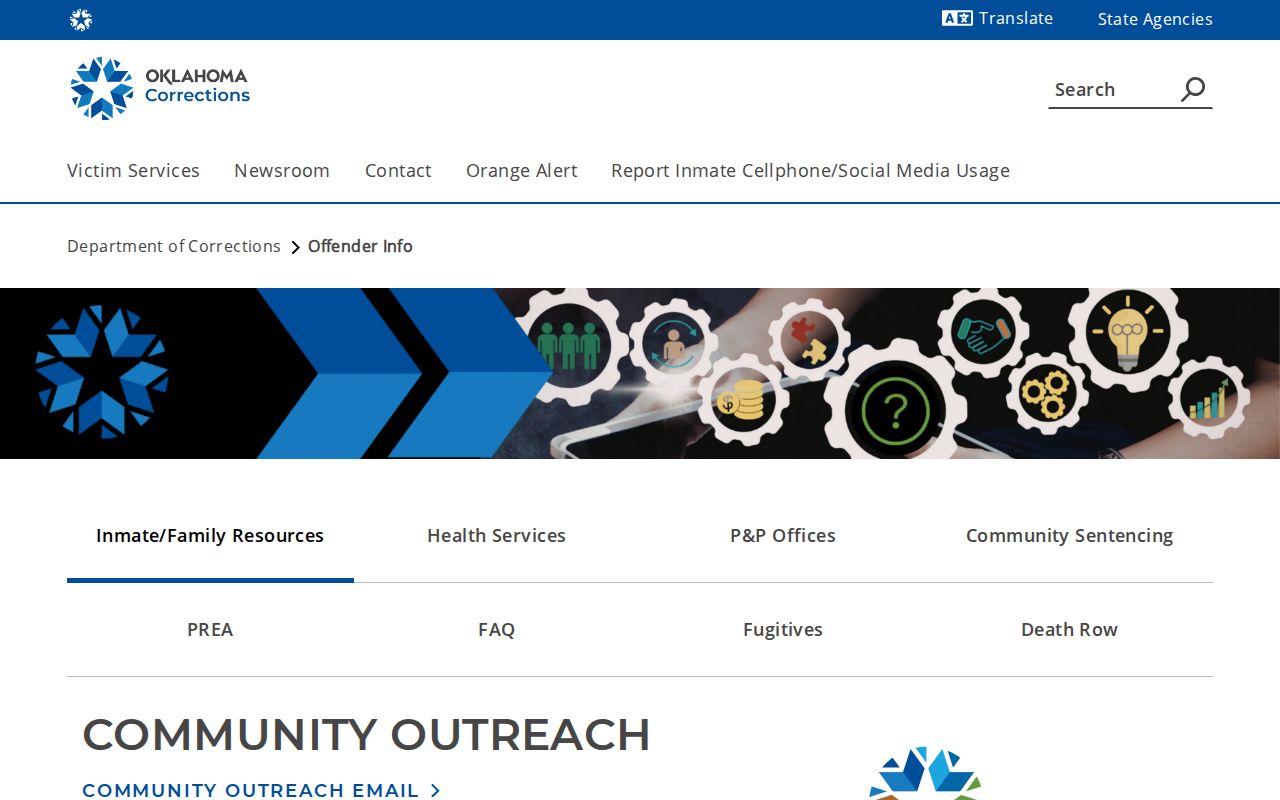
The screenshot supports a cautious rule: report a displayed field exactly as labeled, state when it was checked, and never convert a tentative date into a guaranteed release.
Major County PRD Calculation Inputs
ODOC Sentence Administration begins with the sentence imposed, its effective or commencement date, jail credit, and whether multiple terms run at the same time or one after another. Mandatory restrictions also matter. Staff then apply credits permitted by law and policy, record losses or restorations, and revise the estimate when a sentence or status changes. The legal judgment starts the process; PRD is the operational result.
Every timestamp measures something different. A judge's signature shows judicial action. Bond acceptance shows satisfaction of a release condition. A jail discharge time marks departure from that custodian. VINE marks a transmitted custody event. A website check only shows when the record was observed. If the literal Major County Jail exit matters, prefer the Sheriff's discharge timestamp. If legal authority matters, prefer the filed court order.
A sound audit note records the name searched, identifier, system, date and time with time zone, exact field label, event date, reporting agency, and any mismatch. It should also say whether the date is current, historical, projected, or merely scheduled. That keeps an old estimate from turning into a permanent claim.
Oklahoma Credits and Release Dates
57 O.S. § 138 governs Oklahoma earned credits. ODOC uses monthly class levels, described as levels 1 through 4, and higher levels reflect better status. Credits may reduce a state term calculation. They can be lost through discipline and may be restored under legal and policy rules. Achievement and meritorious credits can also affect the estimate.
Do not apply a flat number of days per month. Section 138 has multiple versions, and the controlling rule depends on offense date, class history, and exclusions. An online summary lacks the facts needed for a personal calculation. Sentence Administration and the facility record are the proper sources.
County jail time is different. The research found no published Major County jail good-time schedule. For a local sentence, use the signed judgment, any jail-credit award, the Court Clerk record, and the Sheriff's actual discharge entry. Importing state prison class credits into the county term would create a date unsupported by local records.
Note: Earned credit affects a calculation; it does not itself prove that all holds cleared or release occurred.
Major County 85 Percent Cases
For offenses enumerated in 21 O.S. § 13.1, Oklahoma requires service of at least 85 percent of the sentence before release consideration through credits or parole as the law provides. The current offense list and the offense date must be checked. A serious-sounding charge should not be labeled an 85-percent offense from memory.
The rule is a constraint, not a public exit-date calculator. Jail credit, consecutive or concurrent terms, statute versions, corrected sentence information, and other custody issues affect administration. Multiplying the pronounced term by 0.85 does not establish the day the person leaves. It also does not answer whether another detainer will change the destination.
Parole eligibility is separate. Under 57 O.S. § 332.7, eligibility depends on offense date and category. The statute includes date-specific rules and exclusions. PPB calculates the docket eligibility date. Eligibility means the person may be considered; it is not a release order or discharge.
Why Major County Dates Change
A PRD can move in either direction. The reason should be tied to an official record rather than inferred from the new number alone. Some changes affect the sentence calculation. Others leave the sentence in place but affect whether the person leaves one custodian or moves to another.
| Factor | Possible effect | Record to check |
|---|---|---|
| Earned or achievement credit | May move the estimate earlier | ODOC sentence and credit record |
| Misconduct and credit loss | May move it later | ODOC disciplinary and calculation record |
| Corrected jail credit | Revises time already credited | Court order and Sentence Administration |
| Concurrent or consecutive correction | Changes total sentence structure | Filed judgment and ODOC record |
| Parole grant or denial | May affect conditional release timing | Validated PPB result, then ODOC status |
| Detainer or hold | Can change timing or receiving custodian | Custodian discharge and receiving record |
| Court modification | Can alter the legal sentence basis | File-stamped court order |
A transfer must be described with care. If Major County discharges a person to ODOC, ICE, USMS, another county, or a tribal agency, county custody ended but community release is not shown. Follow the named destination in its own system.
Confirm Major County Actual Release
Use two independent records when the conclusion is that someone entered the community. The first should come from the custodian, such as a Major County discharge entry or an ODOC historical status. The second should explain or report the change, such as a filed court order, VINE event, parole result followed by ODOC status, or receiving-agency record. Two pages fed by the same vendor are not independent.
OK VINE is useful for a pending custody alert, while the Major County VINELink release check explains how to register and read a transferred result. It is not the permanent certified record. If dates conflict, ask what each one measures, preserve the exact text, and contact the source office. A projected date alone never proves departure.